Have you ever looked at a clothing piece and immediately thought, “This would sell really well in my store”?
It is an exciting feeling. You can already imagine the photos, the customers, and the sales. But then comes the less exciting part: deciding how many pieces to buy, checking the quality, figuring out your margins, and hoping you haven’t just spent your budget on something that will sit untouched for months. Platforms like Fashion go can make discovering wholesale products easier, but finding something attractive is only the beginning.
The truth is, wholesale fashion isn’t just about finding clothes at a good price. It is about finding products that make sense for your customers and your business. Even in Unit 1 of your buying journey, learning how to make that distinction can save you from some expensive mistakes.
The Hardest Part Isn’t Finding Products
There is no shortage of products when you’re shopping for wholesale fashion. You can spend hours scrolling through dresses, tops, denim, accessories, shoes, jewelry, and countless other styles. Fashion go gives retailers access to a large selection of wholesale products and vendors, which sounds like a dream when you’re looking for inventory.
But here’s the funny thing: more choice doesn’t always make buying easier.
When you have hundreds of products in front of you, almost everything can start looking like a potential bestseller. That’s when it’s easy to get carried away. You see something you personally love, imagine your customers loving it too, and suddenly you’re considering an order that wasn’t even part of your original plan.
Start With Your Customer
Before asking “What should I buy?”, ask a more useful question: “Who am I buying for?”
Think about the person who actually walks into your store or visits your website. What do they usually wear? What price range are they comfortable with? Are they looking for everyday outfits, workwear, occasion pieces, trendy styles, or something completely different?
Fashion go gives you plenty of products to explore, but you don’t need all of them. A good buyer learns to filter out the products that don’t fit their customer. That one habit can make your buying process much less overwhelming.
Don’t Let a Pretty Product Photo Fool You
We’ve all done it. You see a great product photo and immediately think the item looks perfect.
But a photograph can’t tell you everything.
How does the fabric actually feel? Is the sizing accurate? Does the material look as good in person? Is the stitching decent? Does the color match the photograph? These details become very important when you’re the person responsible for selling the product.
When browsing Fashion go, take the time to read the product information and understand what you’re actually buying. If samples are available and practical for your business, testing a product before committing to a large order can be a much safer approach.
A product can look amazing on a screen and still disappoint you when the box arrives.
Choosing the Right Vendor Matters
Here’s something that doesn’t get talked about enough: you’re not only buying a product; you’re choosing a supplier.
A great product is useful once. A reliable vendor can be useful over and over again.
You want to know whether the vendor communicates properly, provides accurate product information, maintains consistent quality, and can supply the products you need when your customers start asking for them again. Fashion go can help you discover different wholesale vendors in one place, but you should still do your own research before placing a significant order.
That little bit of extra homework can save you a lot of frustration later.
The Cheapest Product Isn’t Always the Best Deal
Low wholesale prices can be incredibly tempting.
You see a $10 product and immediately start thinking, “If I sell this for $25, that’s a great margin.”
But wait.
What if customers don’t like it? What if the quality leads to returns? What if you have to discount it heavily just to get it moving?
Suddenly, that cheap product doesn’t look quite so cheap.
When using Fashion go, think beyond the initial wholesale price. Consider the quality, expected selling price, shipping, potential returns, and how well the product fits your store.
The better question isn’t “How cheaply can I buy this?”
It’s “How confidently can I sell this?”
Don’t Ignore What the Numbers Are Telling You
Fashion is about creativity, but running a fashion business involves plenty of numbers.
You need to know which products sell quickly, which ones keep getting ignored, which colors customers prefer, which price points work, and which products bring people back to your store.
This is where your own sales history can become incredibly useful. Fashion go can help with product discovery and identifying popular products, but your own customers ultimately provide some of the most useful information.
If a particular style keeps selling out, pay attention.
If another style has been sitting there for three months, pay attention to that too.
Your inventory is constantly giving you feedback. You just have to listen.
What If You Personally Love the Product?
This is one of those mistakes that is incredibly easy to make.
You find something that you absolutely love and think, “I would buy this.”
But you’re not necessarily your customer.
Before ordering from Fashion go, try to separate your personal taste from your customer’s preferences. Ask yourself whether the product fits your store, your audience, your usual price range, and the other products you’re already selling.
Liking something is a good reason to investigate it.
It isn’t necessarily a good reason to buy 50 pieces.
That’s an important lesson to learn early in Unit 1 of becoming a better fashion buyer.
Start Small When You’re Testing Something New
You don’t have to know immediately whether a product is going to become a bestseller.
Sometimes you simply have to test it.
If you’re trying a new category or a style that your customers haven’t purchased before, a smaller order can give you useful information without tying up too much money. Fashion go can be useful for exploring different products and vendors before deciding which ones deserve a bigger place in your inventory.
If the product sells quickly, you’ve learned something.
If it doesn’t, you’ve learned something too.
That’s much better than making a huge purchase based entirely on a guess.
Remember That Shipping Changes the Math
Here’s another detail that’s easy to overlook when you’re excited about a product: shipping.
A wholesale item might look incredibly affordable until you add shipping and other costs. Suddenly, the margin you were imagining isn’t quite as attractive.
That’s why you should think about your total cost rather than focusing only on the product’s listed wholesale price.
When you’re comparing products on Fashion go, think about what the item will actually cost you by the time it’s ready to sell.
A few dollars here and there may not sound important, but across dozens or hundreds of products, those differences can become significant.
Don’t Forget About Cash Flow
Here’s a situation that can catch new boutique owners off guard.
You have a store full of beautiful products.
But most of your money is sitting inside that inventory.
On paper, you might look well-stocked. In reality, you may not have enough cash available to purchase new products, cover expenses, or take advantage of a new opportunity.
That’s why buying too much can be just as dangerous as buying too little.
Use Fashion go as a place to discover products, but always keep your overall cash flow in mind. A healthy business needs inventory that moves, not simply inventory that looks good sitting on a shelf.
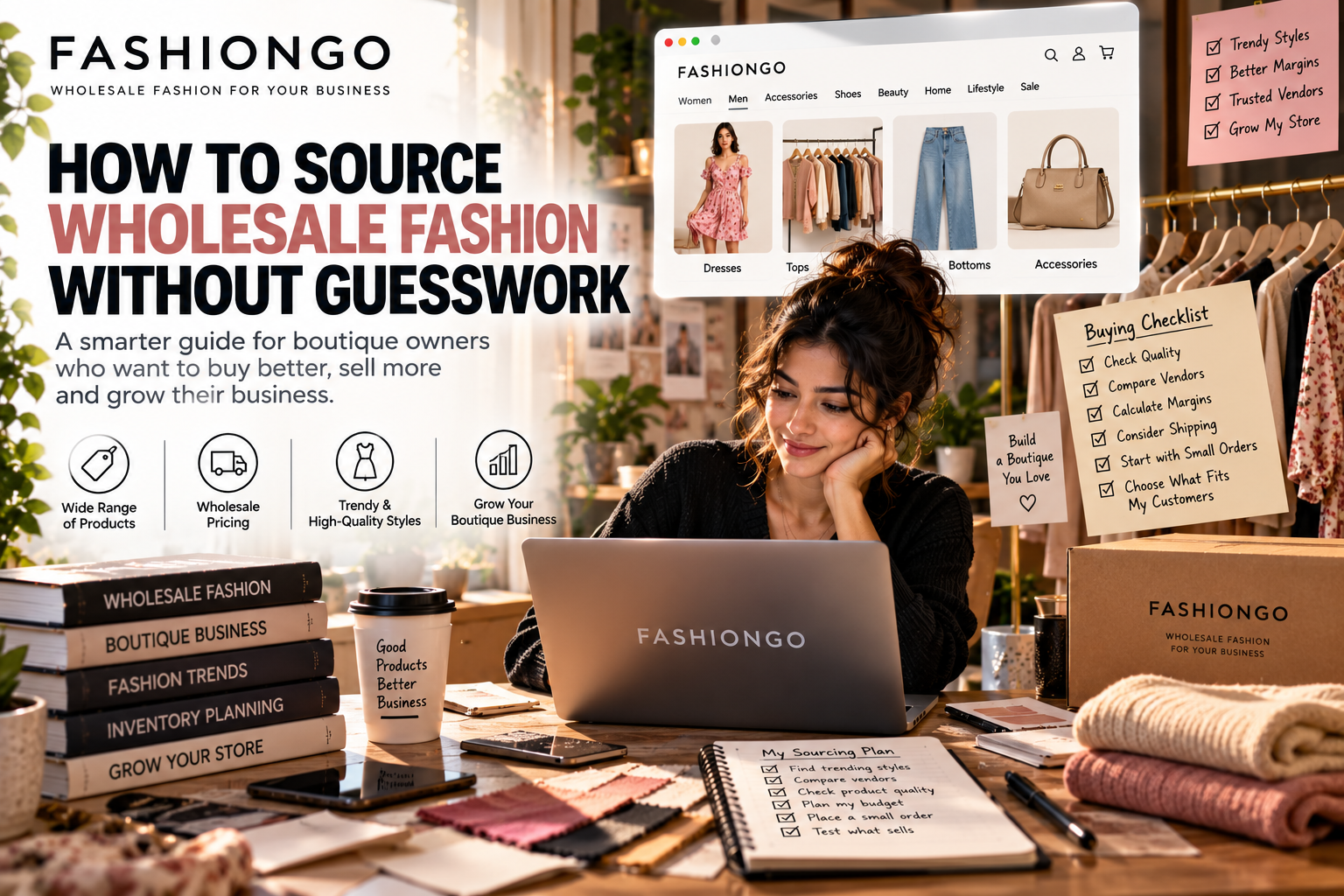
Build a Buying System You Can Actually Follow
You don’t need a complicated spreadsheet with 50 different columns to become a better buyer.
Start with something simple.
Know your customer.
Choose your categories.
Find potential vendors.
Compare products.
Check the actual costs.
Think about your expected selling price.
Test when appropriate.
Track what sells.
Then use what you’ve learned to make your next buying decision.
Over time, Fashion go can become part of that routine rather than a website you visit whenever you’re simply looking for something new.
And that’s an important shift.
You’re no longer shopping for inventory.
You’re building an inventory strategy.
You Don’t Need Every Trend
Fashion moves quickly.
One week, everyone is talking about one style. A few weeks later, something completely different is everywhere.
Trying to chase every trend can leave a boutique with an inconsistent identity and a pile of products that made sense six weeks ago but don’t anymore.
Instead, think about balance.
You might have a few trend-driven pieces that create excitement, alongside reliable basics that customers can return to again and again. Fashion go offers retailers access to a broad range of fashion categories, which can make it easier to build an assortment rather than relying on one type of product.
Sometimes the product that quietly sells every week is more valuable than the product that gets hundreds of likes but barely sells.
Wholesale Fashion Is About More Than Clothes
At first glance, wholesale fashion seems simple: find something you like, buy it for less, and sell it for more.
In reality, there’s a lot more happening behind the scenes.
You’re trying to understand your customers. You’re predicting demand. You’re managing money. You’re choosing suppliers. You’re calculating margins. You’re deciding when to take a risk and when to walk away.
That’s why Fashion go can be useful as part of the process. It gives retailers a place to discover wholesale products and vendors, but the smartest buying decisions still come from understanding your own business.
You don’t need to find every good product.
You need to find the products that are right for your customers.
And once you learn how to tell the difference, wholesale fashion becomes a lot less about guessing—and a lot more about making decisions with confidence.