Your front door lock is something you probably don’t think about very often. You lock the door when you leave, unlock it when you come home and move on with your day. But as smart-home technology becomes more common, homeowners now have more options than simply using a traditional key.
Smart locks can offer keyless entry, smartphone access and connected features, while traditional locks continue to appeal because of their simplicity and familiarity. For homeowners exploring modern door-security solutions, Yale Home is one brand worth considering when comparing different options.
So, should you replace your traditional lock with a smart one?
Not necessarily. The right choice depends on your home, your daily routine and the features you actually need.
In this guide, we’ll compare smart locks with traditional locks and look at what you should consider before upgrading your front door.
What Is a Smart Lock?
A smart lock is an electronic locking system that gives you alternatives to using a conventional physical key. Depending on the model, you may be able to unlock your door using a keypad, smartphone, fingerprint, Bluetooth or another supported access method.
For homeowners researching modern door-security options, Yale Home is one brand worth exploring when comparing different smart-lock solutions.
Some smart locks can also connect with wider smart-home ecosystems, allowing the lock to become part of a larger setup rather than functioning as an isolated piece of hardware.
The main appeal is simple: a smart lock can combine everyday convenience with modern access technology.
What Is a Traditional Lock?
A traditional lock relies on mechanical components and a physical key.
There’s no battery to replace, app to install or Wi-Fi connection to manage. For many homeowners, that simplicity is exactly what makes conventional locks attractive.
When comparing traditional hardware with products from Yale Home, it’s worth thinking about whether you actually need connected features or simply want a straightforward way to secure your door.
Traditional locks can also be familiar to everyone in the household, which can make them easy to use without any learning curve.
For homeowners who regularly misplace keys or need to share access with family members, however, keyless alternatives can offer another level of convenience.
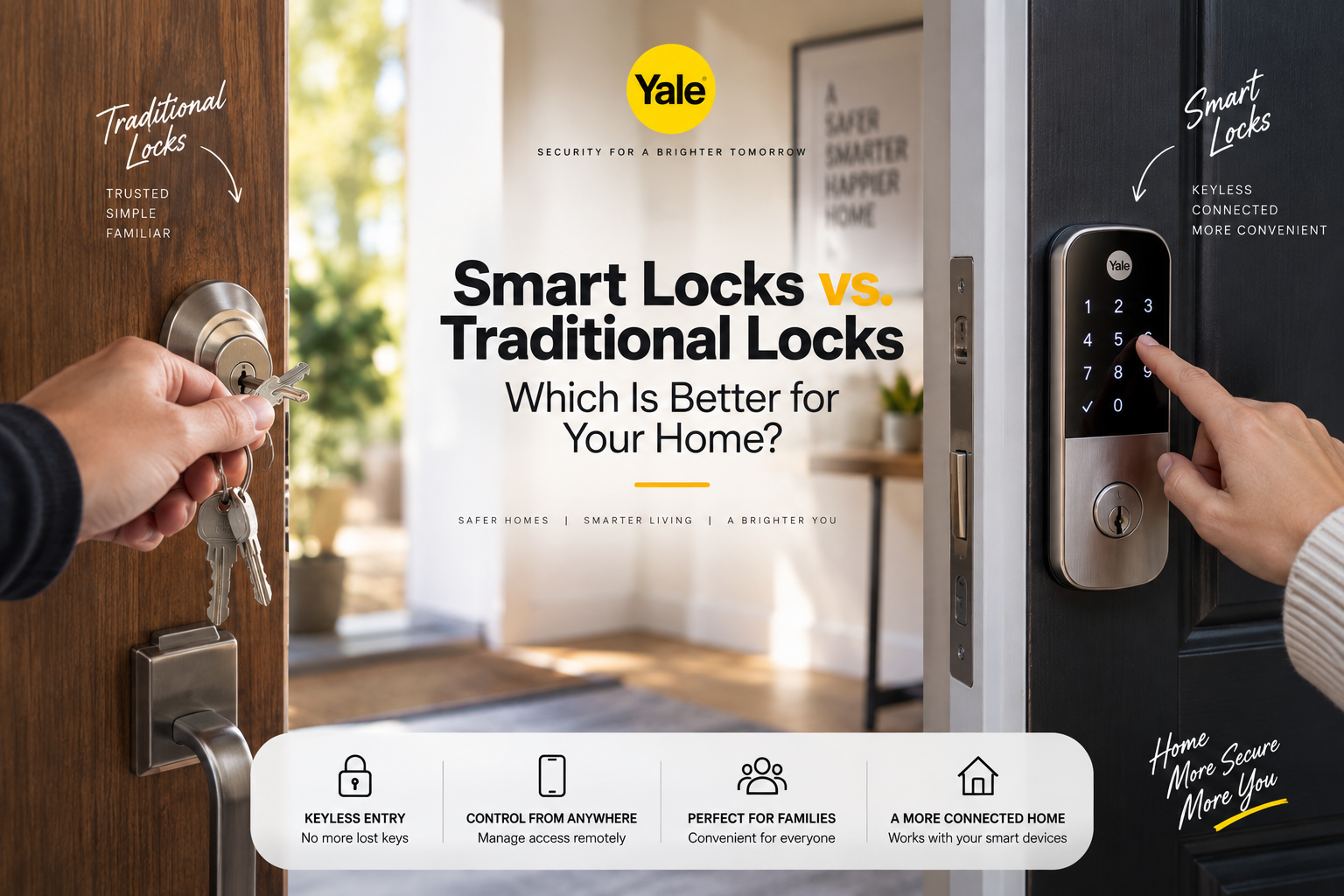
Smart Locks vs. Traditional Locks: What’s the Difference?
The biggest difference isn’t necessarily that one type is universally better than the other.
It’s the way you interact with your front door. A traditional lock requires a physical key, while a smart lock may give you several different ways to enter your home.
When comparing options from Yale Home, pay attention to the access method, connectivity, installation requirements and features included with each model.
Convenience
Convenience is one of the main reasons homeowners consider switching to a smart lock.
Imagine arriving home with your hands full of groceries. Depending on the model, you may be able to unlock the door without searching through your pockets for a key.
Some products can also offer automatic locking or other convenience-focused features.
Keyless Entry
Keyless access is another major difference.
Instead of carrying a physical key, you may be able to use a PIN, smartphone or biometric access method.
This can be particularly useful for families because multiple people can have convenient access without needing several copies of the same physical key.
Remote Access
Certain connected models can offer remote functionality when paired with the appropriate connectivity setup.
This can be useful when you want to manage certain lock functions while you’re away from home.
The exact capabilities depend on the specific product, so it’s important to check the manufacturer’s specifications.
Are Smart Locks More Secure Than Traditional Locks?
This is one of the first questions people ask when researching smart locks.
The answer isn’t simply yes or no. If you’re comparing security options from Yale Home, focus on the specific product rather than assuming every smart or traditional lock provides the same level of protection.
A lock’s overall security depends on the individual hardware, door construction, installation, configuration and how the lock is used.
A smart lock isn’t automatically more secure than every traditional lock, just as a traditional lock isn’t automatically more secure because it doesn’t use electronics.
Instead of comparing the two categories broadly, look at the actual lock and the security and access features it provides.
What Happens If the Battery Runs Out?
Battery life is one of the biggest differences between mechanical and electronic locks.
Traditional locks don’t require batteries, while smart locks rely on a power source for their electronic functions.
Before choosing a connected product from Yale Home, check how the particular model handles low battery levels and what backup access options are available.
Battery management becomes part of owning an electronic lock, so understanding the process before installation is important.
It’s also worth checking how frequently the batteries need to be replaced and whether the lock provides low-battery notifications.
Do You Always Need Your Phone?
Not necessarily.
Although smartphone access is common with connected locks, many keyless entry systems can offer other ways to enter the home.
When comparing Yale Home smart-lock options, look at whether the model supports a keypad, fingerprint access, physical keys or other entry methods that fit your household.
That flexibility can be especially helpful when different people prefer different ways of accessing the door.
A good smart lock should make everyday access more convenient rather than forcing everyone to use the same method.
Who Should Consider a Smart Lock?
A smart lock can be useful for several types of homeowners.
Busy households may appreciate keyless access because multiple people can enter without needing to manage several physical keys. When exploring solutions from Yale Home, think about how the access features would fit into your family’s daily routine.
Families may also appreciate the convenience of not having to hand out spare keys.
People who already use connected lighting, cameras or other smart-home devices may be interested in making their door part of the same ecosystem.
Smart locks can also be useful for people who regularly have visitors and want a more convenient way to manage access.
Who Might Prefer a Traditional Lock?
Smart technology isn’t necessary for everyone.
If you prefer a simple setup without batteries, apps or connected devices, a conventional mechanical lock may still be the better choice.
Even when browsing Yale Home, it’s worth considering whether you actually need a connected product or whether a simpler locking solution fits your lifestyle better.
Traditional locks can be appealing because they’re straightforward and don’t require you to think about software, connectivity or battery levels.
There’s nothing wrong with choosing the simplest solution that meets your needs.
What Should You Look for in a Smart Lock?
If you’ve decided to explore smart locks, don’t automatically choose the model with the longest list of features.
Start with the basics. When comparing Yale Home products, think about which functions you’ll actually use rather than choosing based purely on specifications.
Access Method
Would you prefer a PIN, smartphone, fingerprint or another access method?
Connectivity
Do you need Wi-Fi, Bluetooth or compatibility with a particular smart-home platform?
Compatibility
Not every smart lock is compatible with every door.
Check your existing door hardware and the manufacturer’s installation requirements before buying.
Battery Management
Find out how the lock is powered, how you’ll receive low-battery warnings and what happens if the power runs out.
Installation
Some locks are designed to work with existing hardware, while others may require more extensive changes.
Yale Smart Locks Worth Exploring
Yale offers several approaches to modern door access, so it’s worth comparing the options rather than choosing the first product you see.
If you’re ready to explore the range, Yale Home is the place to compare different smart-lock designs and features.
Yale Assure Lock 2
The Yale Assure Lock 2 is worth exploring if you’re looking for a modern alternative to a conventional front-door lock.
It can be interesting for homeowners who want to move toward keyless access while still considering how the lock fits into their existing setup.
Yale Assure Lock 2 Touch
The Assure Lock 2 Touch is designed for users interested in fingerprint-based access.
Biometric entry can be convenient for homeowners who don’t want to rely on a PIN or physical key.
Yale Assure Lock 2 Plus
The Assure Lock 2 Plus may appeal to homeowners who want smart-home functionality with Apple-related compatibility.
Always check the current compatibility requirements before purchasing.
Yale Smart Lock with Matter
For people interested in smart-home interoperability, the Yale Smart Lock with Matter is another option worth researching.
Matter-compatible devices can be useful for homeowners who want their smart-home products to work across supported ecosystems.
Yale Code Keypad Lock
If you mainly want keyless access without a large collection of connected features, the Yale Code Keypad Lock can be worth considering.
It offers a simpler approach for homeowners who prefer keypad entry.
How Much Should You Spend on a Smart Lock?
Smart locks are available at different price points, and the right budget depends on the features you actually want.
When comparing models through Yale Home, consider whether you’re paying for features you’ll genuinely use.
If your main priority is keyless entry, you may not need advanced functionality such as remote access or broader smart-home integration.
On the other hand, homeowners who want smartphone access, biometric entry or connected features may find that a more advanced model makes sense.
Rather than choosing based only on price, compare the features you’ll use every day.
Should You Buy a Smart Lock?
A smart lock may be worth considering if you value convenience, keyless entry and smart-home functionality.
A traditional lock may be the better choice if you prefer a purely mechanical setup and don’t want to deal with batteries or connected technology.
Before making your decision, you can compare the available options at Yale Home and think about which type of lock fits your home and routine.
There isn’t one universal answer.
The better question is: What do you want your front door to do?
If convenience is your priority, a smart lock may be a worthwhile upgrade.
If simplicity matters more, a traditional mechanical lock may be all you need.
Final Thoughts
Smart locks have changed the way homeowners think about everyday access.
Instead of relying completely on a physical key, you can choose from access methods such as PIN codes, smartphones and biometric entry, depending on the model.
Before purchasing, think about your door, your household, your preferred access method and the features you’ll genuinely use.
Whether you’re looking for a simple keypad solution or a more connected setup, take some time to compare your options at Yale Home before making your decision.
The goal isn’t to choose the lock with the most technology. It’s to find the one that gives you the right balance of convenience, functionality and simplicity.
The best smart lock isn’t necessarily the one with the most features. It’s the one that works best for your home and your everyday routine.